
Exceptional Weather
-Monday, June 25, 2001
This analysis featured in the June 25, 2001 issue of the HGCA's MI Prospect, Volume 3, Number 25
The purpose of this article is to chronicle recent weather events from a cereal market perspective and draw conclusions in the context of harvest and UK supplies for next season.
Key Points
- Seven of eight months of above average rainfall
- Winter and spring cropping effected
- Difficult to assess impact but yields likely to be below trend
- But UK should still have grain to export.
The record rainfall over the 12 months to March 31 this year has received considerable publicity, and has been evident in widespread flooding last autumn, waterlogged fields over winter and some late and very patchy cereal crops this spring. The combination of lower winter wheat area together with a switch in acreage from winter to lower yielding spring barley together some lower potential yields mean that this year's crop will be considerably smaller than last year's.
But as conditions for crop development during the summer are particularly critical, it is too early to make any definitive estimate of output. UK grain export availability will, however, be much reduced.
Rainfall as reflected in monthly data, even aggregated to UK totals, is very erratic (Chart 1). Levels 50 percent above or below long term averages are not uncommon, but rarely do we have an extended period of above or below normal rain fall as we had during the autumn, winter and early spring. Over the six moths from September to April, rainfall was consistently above average with only January close to normal.
continue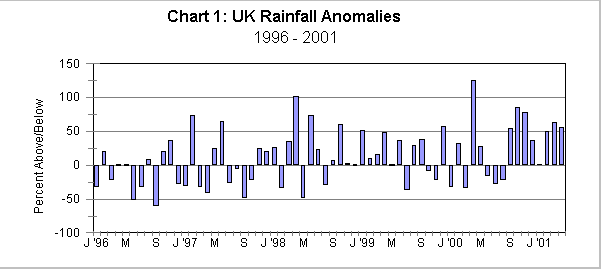
Source: Climatic Research Unit, University of East Anglia
continued
After a relatively dry August which at least allowed for a reasonable harvest in southern England but not in the north, Scotland or Northern Ireland, rainfall from September through until December was consistently above average in all regions. Much of planned autumn cultivation was not completed.
Preliminary data from HGCA's seeding survey suggest that the winter wheat and barley area is almost 500,000 hectares below last year. Spring barley area is up almost 200,000 hectares.
January rainfall was closer to normal, but this minor respite was far from ideal for either catch up winter crop seeding or spring seeding, even if field conditions did dry out enough to allow for any field work.
Poor autumn seeding conditions do not necessarily result in poor crops. In 1999, a very wet October the previous autumn with no really ideal seeding conditions, resulted in a 9.1 percent reduction in area compared with the five percent increase in set-aside that year (Chart 2). Barley area was also down but the proportion of spring barley increased. But by harvest the challenges of the previous autumn had been forgotten and yields of both wheat and barley were quite respectable and above trend.
continue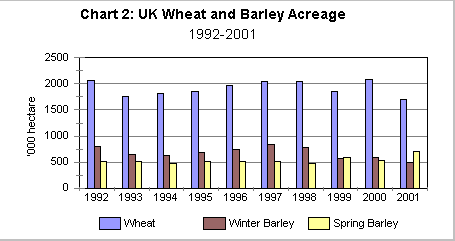
Source: HGCA
continued
This year, in contrast to 1999, the weather continued wet during the normal spring seeding period and early spring development period for winter wheat. This delayed spring seeding and was not conducive to any catch up for winter crops. The result of this is very evident - some very patchy winter crops as a result of water logging wherever drainage was in any way deficient and some very late crops, particularly those which were spring seeded.
The weather related challenges were, of course, further compounded by economics - poor returns on arable farmers in recent years and the foot and mouth outbreak. Attempts to pare overhead costs have resulted in the shedding of extra capacity which might have proved worthwhile this year. While by and large the main cereal growing areas have escaped the worst of foot and mouth, time consuming farm level biosecurity activity to contain the spread of foot and mouth has disrupted arable operations, particularly on farms with livestock.
As fate would have it, May was much drier than usual which already seems to have put shallow-rooted winter barley crops under stress on lighter land and probably has put other cereals susceptible to moisture stress. Most crops are probably somewhat dependent on further rainfall, even though for the previous six months they have suffer from too much.
By the end of April almost all cereal crops were at last in the ground, but stands in May only looked good by March standards. With delayed crop development, green area indexes on June 5, the bench mark date for maximum wheat crop canopies, were from all accounts lower than normal, limiting yield potential for poorer crops regardless of pre-harvest weather conditions.
Looking forward, yield potential will be affected by how quickly the existing crop canopy dies away and how effectively it supports flag leaf and stem development which in turn have greatest effects on yield. Weather, sunshine particularly in June, adequate soil moisture, and moderate temperatures, will in various ways be important in the use and maintenance of the crop canopy and lengthening the period of head filling. As will, of course, effective crop protection.
While a below average canopy resulting from late crop development may not have reduced potential except for the poorest of crops, the risk to yields from adverse weather is probably greater this year than most. Interestingly the success of two standout years for wheat yields, 1984 and 1996, appear to have resulted from relatively cool moisture conditions for the former and for above average sunshine for the latter.
The conflict here is that plants need light and water but hot weather hastens maturity even if conditions are moist. A bright day today may help flag leaf and ear formation, but may hasten the dying off of the canopy and the maturing of the head, and thus prejudice tomorrow if it is either hot or the crop is under moisture stress. In 1996 the above average summer sunshine was not accompanied unduly hot weather.
As much as can be said for wheat yield prospects at this stage is that they are more likely to be below yield trend than above.
For winter barley the situation is somewhat clearer as it is about a month earlier in maturing. May was warm, dry and sunny, on balance the type of conditions that past experience suggests are not kind to the crop. Also barley tends to be less tolerant to adverse weather with wider ranges in UK historic yields (Table 1).
continue
Table 1: Range of Yields from Trend Averages,
         1991-2000, selected countries

	Top of range	Bottom of range
	% above	year	% below	year
Wheat
UK	7.8	1996	-5.2	1992
France	5.6	1990	-6.7	1997
US	8.5	1998	-9.4	1991
Canada	9.7	1999	-7.3	1997
Barley
UK	8.9	1996	-8.44	1998
France	11.90	1991	-7.24	1994
Canada	7.89	1993	-5.04	1997

Source of yield data: USDA
continued
Using a combination of trend yields and preliminary area estimates, total supply of wheat and barley is estimated to be about 20 million tonnes, about nine percent above last year's domestic consumption. This suggests reduced export availability next season, but, even after allowing for relatively poor crop development conditions between now and harvest, the UK is still likely to be a net exporter of grain.
David Walker 01603 705153
Web site addresses:
Met Office, UK climate and weather statistics
http://www.met-office.gov.uk/climate/uk/2001/
Climatic Research Unit, University of East Anglia, Data sets/UK Climate/Monthly
http://www.cru.uea.ac.uk/~mikeh/datasets/uk/month_uk.htm
top of page